The Enzyme Molecule
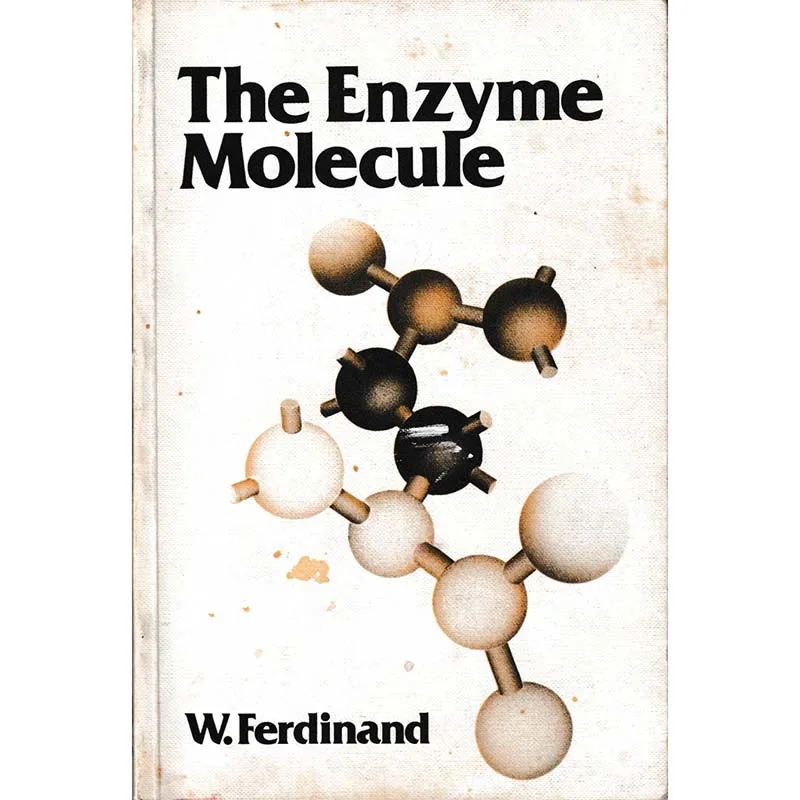
Publisher: John Wiley and Sons
Format: Paperback
ISBN: 047101821X
The Enzyme Molecule (1980) – W. Ferdinand
John Wiley & Sons • ISBN: 047101821X • Condition: Good
Kinetically serious, biochemically nostalgic, from Crappy Old Books
If you’ve ever sat in a lab wondering why your reaction is slower than your will to live, The Enzyme Molecule is the stern, data-driven friend you apparently needed all along.
This is 1980s biochemistry, when:
-
Graphs were drawn by hand
-
Computers were optional, but Lineweaver–Burk plots were not
-
And enzymes were discussed with the kind of reverence usually reserved for opera and expensive glassware
W. Ferdinand is here to guide you through the gloriously uncompromising world of enzyme kinetics, structure, inhibition, and general catalytic drama. It’s not cute. It’s not chatty. It is weirdly satisfying.
Condition: Good (like a well-folded lab coat)
When Crappy Old Books says Good, we mean:
-
The cover is intact and academically serious – classic Wiley: no nonsense, no cartoons, just “you are definitely reading a biochemistry book.”
-
The spine is sound, possibly with a light crease or two from previous skirmishes with Michaelis–Menten.
-
All pages present, securely bound, and readable – no missing derivation, no lost appendix, no mysterious gap where the inhibition section used to be.
-
Normal, respectable wear: softened corners, very mild shelf-rub, perhaps a faint sense of “someone once crammed for an exam using this and survived.”
No fluorescent highlighter atrocities on every page, no coffee tsunami stains, no pages stuck together with buffer solution. Just a well-kept, Good condition veteran of serious study.
What’s brewing inside the active site of this book?
Expect:
-
Proper enzyme kinetics:
-
Michaelis–Menten, Lineweaver–Burk, Eadie–Hofstee – all the plots, all the slopes, all the ways to find out that yes, you pipetted something wrong.
-
-
Discussions of enzyme structure and mechanism that talk to you like a grown-up:
-
Binding sites, transition states, catalytic residues, the whole molecular soap opera.
-
-
Inhibition in all its flavours:
-
Competitive, non-competitive, uncompetitive, and “why does this graph look like that?”
-
-
A tone that says:
“We are here to understand reality at the molecular level. Kindly bring your brain.”
This is not “Enzymes For People Who Are Sort of Curious.”
This is “Enzymes For People Who Need To Pass And Possibly Publish.”
A love letter to pre-PowerPoint science
Reading The Enzyme Molecule today feels like sliding into a slightly scratchy lab coat from another era:
-
Figures and diagrams drawn with care, not yanked from clip-art.
-
Algebra that expects you to follow along without collapsing.
-
Explanations that assume you might actually want to derive the equation, not just memorise it for multiple choice.
It’s comforting, in a demanding, slightly intimidating way. Like an old lecturer who doesn’t smile much but really knows their stuff.
Why on earth would you want this now?
Because:
-
You’re studying enzymes and your modern textbook keeps “simplifying” everything until it’s practically decorative.
-
You’re a lab person who wants a solid kinetics reference that isn’t secretly just a web article with good lighting.
-
You collect vintage science texts and love that late-20th-century mix of heavy maths and earnest prose.
-
You secretly enjoy working through rate equations with a pencil and feel mildly betrayed by software that does it for you.
Use it to:
-
Check your intuition about enzyme behaviour.
-
Bulk up your reference shelf with something that clearly means business.
-
Intimidate undergraduates by leaving it open on your desk at a particularly brutal graph.
Why a Good used copy is exactly right
Enzyme books are meant to be used, not worshipped.
From Crappy Old Books, this Good copy:
-
Already looks like it’s seen at least one cohort of confused students and come out unscathed.
-
Has enough life in it to be annotated, bookmarked, and left open in the lab without causing you to wince.
-
Carries that comforting “this has survived real work” aura: a text that’s been around long enough to prove it’s not all nonsense.
It’s not a relic. It’s a working biochemical tool with a bit of history and no ego.
Ideal for readers who:
-
Like their biochemistry dense, precise, and low on small talk
-
Are revising for exams, designing assays, or just pretending to
-
Enjoy seeing the foundational logic behind what enzyme software spits out in 0.3 seconds
-
Appreciate that all the shiny structural biology in the world still bows to kinetics in the end
Also great for:
-
Lab libraries
-
Nerdy gifts to overachieving postgrads
-
Background reading for anyone writing fiction about scientists who actually sound like scientists
The catalytic facts
-
Title: The Enzyme Molecule
-
Author: W. Ferdinand
-
Publisher: John Wiley & Sons (1980)
-
ISBN: 047101821X
-
Condition: Good – gently worn, scientifically intense, structurally sound
The Enzyme Molecule: for when you’re ready to move past “enzymes speed things up” and into “let’s talk about rate constants until someone cries.” Supplied in honestly Good condition by Crappy Old Books, proud enablers of serious biochemical overthinking since quite a while ago.
Keep browsing: See more Academic books Other books by W Ferdinand